
Information reviewed: September 30, 2026
Imagine leaving home unexpectedly and reaching a safe place. Your phone battery is nearly empty. You need your pharmacy number, but it is saved only on your phone. Your insurance papers are still in a drawer at home.
This is a planning example, not a prediction. It shows why collecting documents is only half the job: you also need to find and use the right information when your usual tools are unavailable.
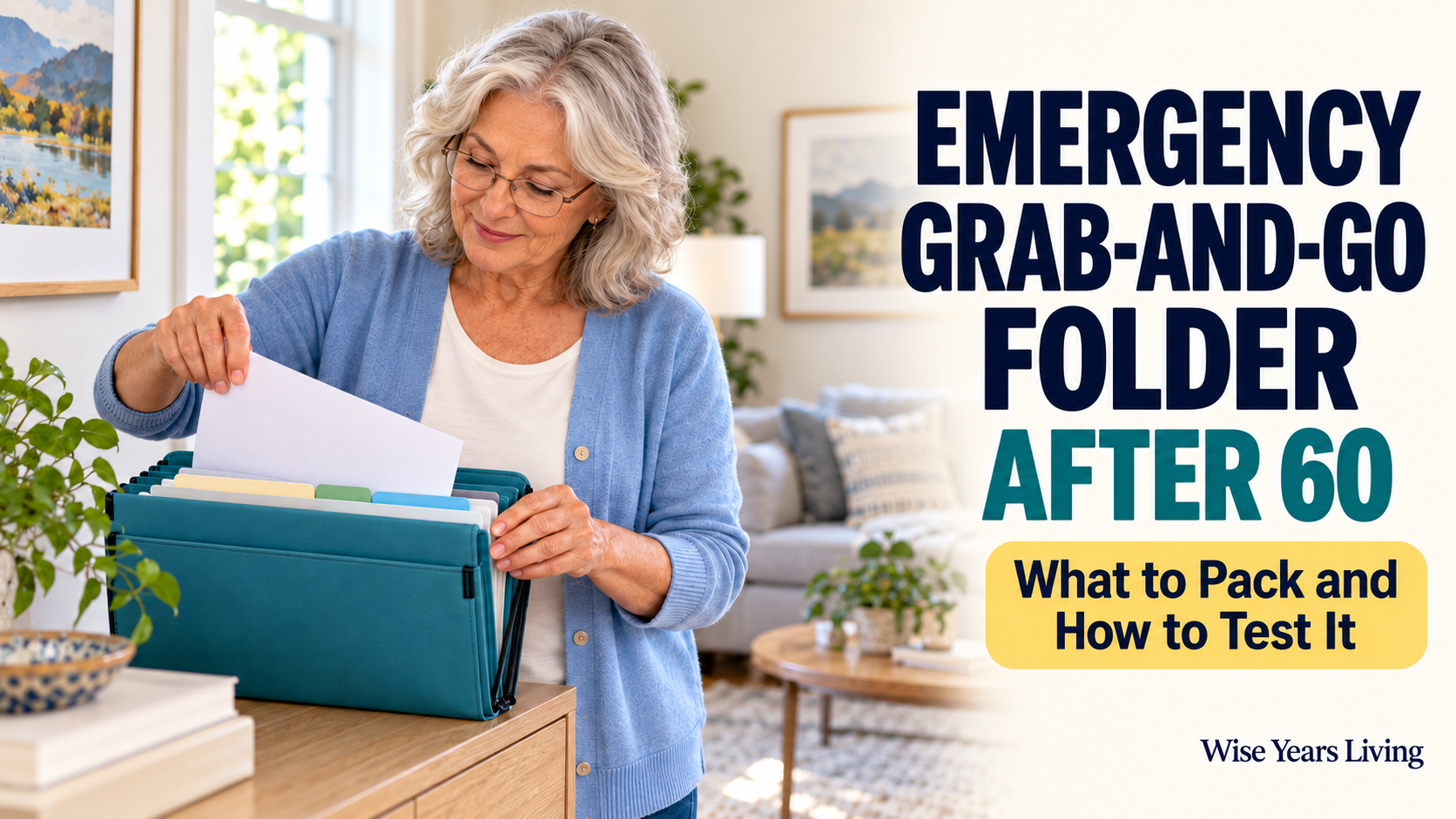
An emergency grab-and-go folder holds essential information and selected document copies. This guide helps you choose what to carry, protect private records, and test whether the folder works without your phone.
Safety comes before paperwork. Never delay escape from a fire or another immediate danger to retrieve documents. If your folder is not safely within reach, leave it behind. Follow local emergency instructions. Call 911 for an immediate emergency.
Start With These Three Questions
- Could I find my medication list and pharmacy number without my phone?
- Could I open, read and carry my folder using my usual glasses or mobility aid?
- If I left the folder behind, would an appropriate backup still be available?
If an answer is no, you have a useful starting point. You do not need to buy a special binder or gather every document today.
The American Red Cross recommends preparing important document copies and current medical information. The arrangement and practice steps below are WYL suggestions for putting that guidance to use, not a government certification of preparedness.
1. Choose Documents by the Job They Need to Do
For each document, ask: What would I need this for if I could not return home? Separate immediate information from your larger protected records collection.
| Need | Portable information to consider | What to check |
|---|---|---|
| Reach help | Primary and backup contacts; doctor and pharmacy phone numbers | Print the numbers. Do not rely only on phone contacts. |
| Explain health needs | Current medication and allergy list; essential conditions and support needs | Check names, strengths, doses and schedule. Ask your pharmacist if unsure. |
| Find identity or coverage information | Selected photo ID and health or prescription insurance copies | Copy both sides where useful. Protect identifying numbers. |
| Begin housing or insurance recovery | Insurer contact and policy information; relevant lease or ownership records | Select records for your circumstances rather than copying years of paperwork. |
| Locate existing care instructions | Relevant completed advance directive or other care documents, if you have them | Use current versions and check applicable requirements. |
| Find additional records | Protected original and backup locations, with appropriate contact information | Plan who can obtain them and how. |
A renter may prioritize a lease and landlord contact. A person using medical equipment may need the supplier’s number. Include pet vaccination records or veterinary contacts if they are relevant to your plan.
Broader records such as tax returns, benefit information and detailed financial documents may matter later. The CFPB and FEMA disaster checklist helps you review that larger collection. A portable folder is a selected part of your preparedness system, not a reason to discard other records.
Video: Which Documents Help After a Disaster?
This video from Bay Area Legal Services explains why selected identity, housing, and insurance records can help after a disaster. Pay particular attention to the insurance declarations page and the information it provides for starting a claim.
Document requirements vary. Follow local re-entry instructions, ask the relevant agency what proof it accepts, and plan protected access to important originals.
2. Put Immediate Information First
Start with an existing emergency information sheet if you have one. Keep contacts, current medication and allergy information, and important support needs easy to locate.
Use direct wording: “I use a walker and need help on stairs,” or “Please face me when speaking; I have difficulty hearing.” Include your preferred language or need for written instructions when relevant.
The medication list informs care; it does not tell another person to change your treatment. Check uncertain details with your pharmacist or healthcare professional. The list does not replace your medicines.
For broader planning about home access, helpers, pets and transportation, use If You Live Alone After 60: What Should Someone Be Able to Find in an Emergency? Reuse useful information rather than maintaining conflicting lists.
3. Protect Sensitive Copies Inside the Folder
Use a plain outer label such as “Emergency Information.” Keep identification, insurance and financial records inside a closed section, protected from casual viewing. Even a medication page contains private information.
Organization is not security. A zipper, colored tab or sealed envelope helps separate documents. It does not prevent someone from reading them. Do not display Social Security numbers, account numbers, passwords or door codes on the cover or an open contact sheet.
For initial contact, a financial institution’s name and verified phone number may be useful. Additional records may be necessary for a transaction or claim; keep appropriate records in your protected system.
Keep secret credentials—passwords, PINs and recovery codes—separate from an easily accessible folder. For authorized account access and recovery arrangements, use the WYL Digital Emergency Plan.
4. Know the Limits of a Copy
A copy can help you locate information or start a conversation. Do not assume it replaces an original, certified copy or other required proof. Acceptance depends on the institution and purpose.
Check requirements in advance for documents that are especially important to you. Do not redact a copy you intend to submit without checking whether the receiving institution needs the missing information.
If you have completed an advance directive, consider keeping a current copy available. The National Institute on Aging recommends sharing completed forms with appropriate healthcare providers, your healthcare proxy and your lawyer, if you have one. State requirements and personal circumstances vary.
Do not create homemade medical orders for the folder. Listing a helper does not itself establish legal authority; ask an appropriate professional about arrangements that require it.
5. Plan for Originals and a Separate Backup
Decide which originals require protected storage and whether any need to be taken under your personal plan. Record how an authorized person can obtain important originals if needed. Consider keys, access hours and authorization—not just the storage location.
The CFPB recommends separate document copies and protected digital backups. A spare copy next to the folder can be affected by the same incident.
Choose an appropriate separate location or protected digital system. If a trusted person holds a backup, agree on what they may hold and use. They do not need unrestricted access to every record.
If you use digital storage, test access without assuming your usual phone is available. Do not solve an access problem by exposing your passwords.
Watch: Official Guidance on Disaster Financial Preparation
The CFPB includes this video on its disaster-preparation page. Use it as background for organizing records, then apply the document-selection and practice steps in this guide.
Watch the video linked from the CFPB disaster-preparation page
Open the CFPB page if the video does not load.
6. Check Readability, Reach and Weight
Try an existing lightweight folder. Can you open the closure, read its contents and safely carry it alongside your usual equipment? Avoid storage that requires climbing or heavy lifting.
Use clear headings and comfortably large type. Try 16-point print for the quick-reference page and adjust it to your needs. Label tabs with words even if you use colors. For a couple, clearly distinguish each person’s medical information.
Ready.gov recommends a waterproof container for important documents. Check a product’s stated limits. Do not assume an ordinary folder or plastic bag is fireproof or protects against every flood. Keep a separate backup.
7. Run the No-Phone Practice
Try this on an ordinary day, without rushing.
- Retrieve the folder safely.
- Find your pharmacy number and current medication list.
- Find the relevant insurer contact.
- Find where an important original or backup is kept.
- Open, read and carry the folder with your usual glasses or equipment.
If appropriate, ask a trusted helper to find one section with your permission. They do not need to read private records to test the labels.
Write down what was difficult and fix that problem: tiny print, an old phone number, unclear tabs or an awkward closure. This is a usability exercise, not a timed evacuation drill or proof that every emergency need is covered.
8. If the Folder Is Missing or Documents Are Lost
Get to safety first. Use a wallet contact card, your trusted helper or a protected backup if available.
If you are missing records needed for a service or claim, contact the actual provider, insurer or agency using a verified contact method. Ask what replacement or alternative documentation it accepts. Do not assume missing papers make you ineligible, and do not assume a copy guarantees approval.
Keep control of your folder when seeking help. Show only what the task requires. Do not hand the full collection to someone offering unsolicited assistance or upload it through an unexpected message. The CFPB disaster checklist warns about people using disasters to scam those seeking help.
Download: Grab-and-Go Folder Checklist & Readiness Test
Use the two-page WYL checklist to turn reading into preparation. Page 1 helps you select and protect records. Page 2 checks whether you can find, read and carry the folder without your phone.
The checklist does not ask you to enter account numbers or passwords. If you add personal notes, keep it private. Never send completed records to Wise Years Living.
You can also use the quick check below without downloading anything.
- Essential contacts and checked medication information are printed.
- Relevant document copies are readable and protected.
- Secret credentials are stored separately.
- Original and backup access has been planned.
- The folder can be safely reached, opened, read and carried.
- The no-phone practice has been completed.
- A fallback exists if the folder is unavailable.
Download the free two-page checklist (PDF)
9. Keep the Working Information Current
Write a “Last checked” date on the first page. Update after changes to medications, contacts, insurance, housing, equipment or care documents. The Red Cross recommends refreshing emergency plans, supplies and important documents every six months.
Replace stale everyday contact and medication sheets and securely dispose of unnecessary sensitive duplicates. Follow professional guidance for older legal documents rather than automatically destroying them.
Frequently Asked Questions
Do I need an expensive binder?
No. Readability, portability, document protection and reliable access matter more than a special product. Test what you already have.
Should I keep the folder in my car?
Consider theft, heat, privacy and whether you could reach the vehicle. Choose a location that fits your routine and keep a separate backup.
What if I do not have family nearby?
A trusted helper could be a friend or another appropriate person. If no suitable helper is available, prioritize printed contacts and backups you can access yourself. Ask local aging-services or emergency-management offices about planning resources.
Does a document folder replace my emergency kit?
No. You still need plans for medications, supplies, equipment, communication, pets where relevant and transportation. Do not delay evacuation to finish this folder.
Choose One Task Today
Print your pharmacy number and check your medication list. Put them with your emergency contacts. Choose a protected, reachable location, then practice finding the information without your phone.
For more practical guides on independent living and digital safety, explore the related WYL articles linked above. If you choose to subscribe to Wise Years Living, use the site’s newsletter signup; keep your personal emergency records offline and private.
Sources and Further Reading
- American Red Cross: Emergency Preparedness for Older Adults
- CFPB: Get Prepared Before a Disaster or Emergency Strikes
- CFPB and FEMA: Your Disaster Checklist (January 2023)
- Ready.gov: Floods
- National Institute on Aging: Advance Directives for Health Care
Safety and Educational Notice
This article provides general emergency-preparedness information, not individualized medical, legal, financial or insurance advice. Document requirements and personal needs vary. Ask the appropriate professional or institution about your circumstances. For an immediate emergency, call 911 or follow local emergency instructions. Never delay getting to safety to collect documents.