
Information reviewed: October 8, 2026 | United States
Imagine hearing your granddaughter’s voice on the phone.
“Grandma, I’ve been in an accident. Please help me. I need money right now.”
She sounds frightened. She knows your name. The voice sounds familiar.
Then another person gets on the phone, claims to be a lawyer, and tells you to keep the situation secret.
What should you do?
Artificial intelligence can help scammers imitate a loved one’s voice. The Federal Trade Commission (FTC) warns that criminals may use voice cloning to make a fake family emergency sound real.
But you do not need to become an AI expert to protect yourself.
You need a reliable way to verify an emergency before sending money.
This guide provides a quick-response card, a step-by-step verification plan, realistic family situations, and a worksheet you can use with someone you trust.
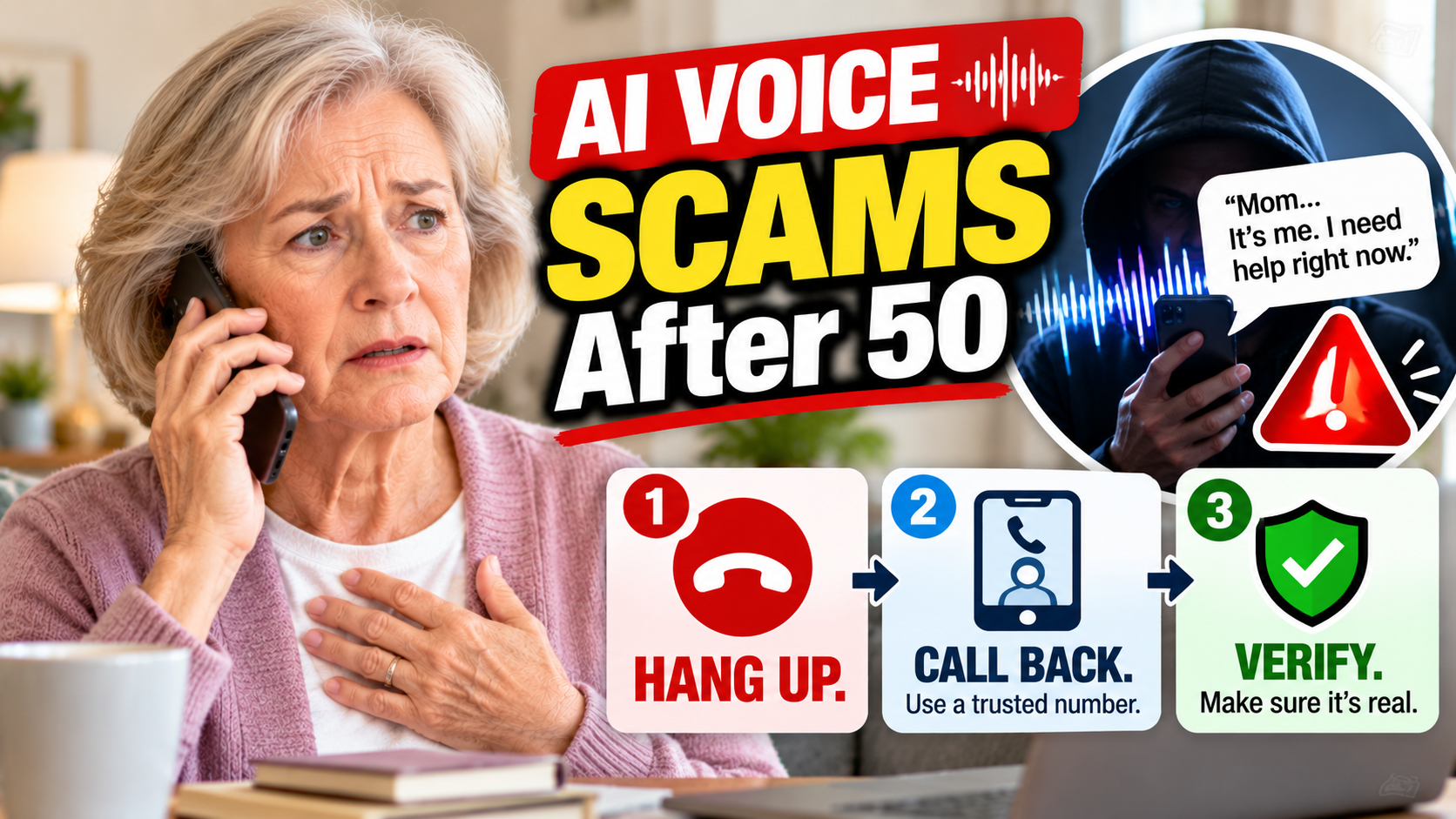
Your First Response: STOP → DISCONNECT → VERIFY
If an unexpected caller claims a family member is in trouble and asks for money, remember these three steps.
1. STOP
Do not send money, share a verification code, or provide banking information.
You can say:
“I want to help. I’m going to call you back using the number I already have.”
You do not need to argue with the caller or prove the call is fake.
2. DISCONNECT
End the unexpected call.
Do not use a callback number supplied by the caller. Do not assume the number on your caller ID is genuine.
Scammers can manipulate caller ID information.
3. VERIFY
Call your family member using a number you already know is theirs.
If they do not answer, contact another trusted person who may know where they are.
If the story involves a hospital, police department, or lawyer, independently find that organization’s official contact information.
Do not make an unexpected emergency payment until you have independently verified the situation and the payment request.
These steps begin your response. There is no deadline for completing verification.
Important: If credible information indicates an immediate threat to someone’s life or safety, contact appropriate emergency services. Do not delay urgent help merely to finish a fraud check.
Why a Familiar Voice Is No Longer Proof
The FTC has warned that scammers can use a short recording of someone’s voice to create a convincing imitation.
A recording might come from a video or other audio shared online.
The FBI has also warned that criminals use AI-generated audio and video to impersonate people and encourage fraudulent payments or disclosure of sensitive information.
That means several familiar clues may no longer be reliable on their own:
- A voice that sounds like your grandchild
- A face that resembles a relative during a video call
- A phone number that appears familiar
- A message containing real family details
- A person claiming to be a lawyer, police officer, or hospital employee
None of these details independently confirms who is contacting you.
The safer question is not “Does this sound real?” It is “Can I verify this through a trusted, separate source?”
The WYL Family Emergency Verification Ladder
When a call feels urgent, it can be difficult to decide what to do next.
Use this ladder to move from an unverified claim toward reliable information.
| Step | What to do | What you are checking |
|---|---|---|
| 1. Call back | Call your loved one’s previously verified number. | Can you reach the actual person? |
| 2. Use a separate contact method | Try another method you established before the suspicious request. | Can you obtain independent confirmation? |
| 3. Contact a backup person | Call a trusted relative, friend, or household member. | Does someone else know what is happening? |
| 4. Check the institution | Find the official contact information for the claimed hospital, police department, or other organization. | Can the claimed event or institution be verified? |
| 5. Respond to genuine danger | If credible evidence suggests immediate danger, contact appropriate emergency services. | Is urgent safety assistance needed? |
You may not need every step.
An unanswered phone call does not prove an emergency. It also does not prove that your loved one is safe.
If you cannot reach them, continue checking through independent contacts rather than relying on the person demanding money.
A genuine emergency can require urgent assistance without requiring an immediate payment to an unverified person.
For broader family preparedness, see our Digital Emergency Plan After 60 guide to organizing essential digital information and trusted contacts.
Four Family Situations and the Safest Next Step
Situation 1: A Grandchild Calls From an Unfamiliar Number
You receive a call late at night.
The voice sounds like your grandson. He says he was arrested, has a new phone number, and needs you to send money immediately.
He asks you not to tell his parents.
What to do:
End the call. Call your grandson’s saved number.
If he does not answer, contact a parent, sibling, roommate, or another previously trusted person.
Do not treat the unfamiliar number as verified because the voice sounds convincing.
Your preparation step: Make sure you have a backup contact for relatives who live far away.
Situation 2: Your Spouse Receives a Hospital Payment Request
Your spouse receives a message saying your daughter was injured.
You then receive a call from someone claiming to work at a hospital. The caller says you must pay immediately.
What to do:
One of you contacts your daughter through her usual number.
The other independently looks up the hospital’s official contact information.
Do not assume two matching messages prove the claim. They could come from the same fraudulent source.
Your preparation step: Agree in advance that neither spouse will make an unexpected emergency payment based only on an incoming call or message.
Situation 3: You Live Alone and Cannot Reach Your Family Member
A caller says your adult child is in trouble.
You hang up and call your child, but there is no answer.
The caller contacts you again and says the delay will make everything worse.
What to do:
Do not let the caller’s pressure substitute for verification.
Try another previously trusted contact method and reach a backup person who may know your child’s whereabouts.
If there is credible evidence of immediate danger, contact appropriate emergency services.
Your preparation step: Keep a small list of trusted backup contacts in a secure, accessible place.
Situation 4: The Request Comes Through Video
Someone who appears to be your relative calls through a messaging app.
The person looks familiar and asks for an urgent transfer to a new account.
What to do:
Do not rely on the video image alone.
End the unexpected conversation and contact the person through a previously verified channel.
If their account may have been compromised, use a different trusted contact or family member.
Your preparation step: Tell your family that video calls and familiar voices do not automatically authorize a payment.
A Family Code Word Can Help — But It Is Not Enough
The FBI recommends creating a secret word or phrase with family members as an additional identity check.
That can be useful.
However, a code word should not be your only verification method. Someone might overhear it, learn it from a compromised message, or obtain it from another person.
If your family uses one, combine it with an independent callback or trusted backup contact.
Do not use birthdays, account passwords, banking PINs, Social Security numbers, or one-time login codes as verification phrases.
The most important family rule remains: Verify independently before making an unexpected payment.
What If the Emergency Is Real?
Scam prevention should not prevent you from helping someone who genuinely needs assistance.
Once you independently confirm an emergency, determine what kind of help is actually needed.
Ask yourself:
- Has the person’s identity been confirmed?
- What happened, and who independently confirmed it?
- Is emergency medical or safety assistance needed?
- Is someone requesting money, and why?
- Have you independently verified the payment recipient and purpose?
For example, your family member might genuinely be in a hospital while a separate scammer falsely claims you must send money to a personal account.
Confirming that an emergency happened does not automatically confirm every related payment request.
If someone needs immediate emergency assistance, contact the appropriate emergency service rather than relying on an unfamiliar caller’s payment instructions.
The WYL Family Scam-Verification Worksheet
This worksheet is different from a general emergency binder.
Its purpose is specific: help your family verify unexpected emergency messages and payment requests.
Complete it together before anyone receives a frightening call.
Part A: Our Verification Contacts
| Role | Name or initials | Where to find the verified contact information |
|---|---|---|
| Primary family contact | __________ | __________ |
| Backup family contact | __________ | __________ |
| Additional trusted person | __________ | __________ |
Confirm these contacts directly with the people involved.
If you record actual phone numbers, keep the completed worksheet private and protected.
Part B: Our Payment Verification Rule
Complete this sentence together:
Before making an unexpected emergency payment, our family will:
Suggested rule:
“We will independently confirm the person’s identity, the emergency, the payment recipient, and the reason for payment.”
Part C: If No One Answers
First backup person to contact:
Second trusted contact method:
What we will do if there is credible immediate danger:
Part D: Our Practice Checklist
- We know how to end a suspicious call.
- We know where to find previously verified numbers.
- We have at least one backup contact.
- We will not rely on a familiar voice or face alone.
- We will independently verify an unexpected payment request.
- We will not disclose passwords or one-time login codes.
- We know how to contact emergency services when necessary.
- We have practiced this response together.
Last reviewed: __________
Next review: __________
Do not write banking passwords, account numbers, Social Security numbers, authentication codes, or recovery codes on this worksheet.
Do not submit a completed copy containing personal details to Wise Years Living.
Practice the Response in Five Minutes
A plan becomes more useful when someone has practiced it.
Ask a trusted family member to pretend they are making an unexpected emergency request.
Then rehearse the response:
First: “I want to help, but I need to verify this.”
Second: End the pretend call.
Third: Explain which previously verified number you would use.
Fourth: Identify your backup contact if the first person does not answer.
Fifth: Agree that no unexpected payment will be made solely because a caller demands secrecy or urgency.
This practice does not guarantee protection from every scam.
It gives your family a familiar procedure to use when emotions are high.
What If You Already Sent Money?
Act promptly.
The FTC recommends contacting the company or financial institution used to send the payment, reporting the fraudulent transaction, and asking whether the money can be recovered.
| How you paid | What to do first |
|---|---|
| Zelle or bank transfer | Contact your bank or credit union immediately and report the scam. |
| Venmo, Cash App, PayPal, or another payment app | Contact the payment service. If a card was linked, contact the card issuer or bank as appropriate. |
| Credit or debit card | Contact the card issuer or bank through an official channel. |
| Wire transfer | Contact the bank or wire transfer company immediately. |
| Gift card | Contact the card issuer and keep the card and receipt. |
| Cryptocurrency | Contact the exchange, ATM operator, or service used and report the transaction. |
| Cash sent by mail | Contact the U.S. Postal Inspection Service promptly to ask about available options. |
Explain what happened and ask about a reversal, refund, or other available fraud response.
Recovery is not guaranteed. The options depend on the payment method and circumstances.
If you shared login credentials, change affected passwords through the official website or app. If you shared personal information that could be used for identity theft, visit IdentityTheft.gov for recovery guidance.
Beware of a Second Scam: Fake Recovery Assistance
After losing money, you may receive another call, email, or message from someone claiming they can recover it.
They may claim to work for the FBI, the Internet Crime Complaint Center (IC3), or another government agency.
The FBI warned in July 2026 that scammers were impersonating IC3 and using fraudulent websites and communications to target people, including previous scam victims.
Do not trust an unexpected offer to recover your money.
Do not pay an upfront fee to someone who contacts you claiming they can retrieve stolen funds.
Go directly to official reporting websites yourself.
Where to Report a Suspected Scam
Federal Trade Commission (FTC)
Report suspected fraud, including attempts that did not result in a payment.
FBI Internet Crime Complaint Center (IC3)
Use the official website to report suspected internet-enabled crime.
Keep relevant messages, phone numbers, payment records, and dates when possible. Do not send sensitive information to people who unexpectedly contact you claiming to assist with a report.
For an immediate life-threatening emergency in the United States, call 911.
Frequently Asked Questions
Can AI really imitate a family member’s voice?
Yes. The FTC and FBI have warned that AI-generated audio can be used to impersonate relatives and other trusted people.
What if the caller knows private family information?
That does not establish identity. Scammers may obtain information from online sources, compromised accounts, or other means. Verify through a separate trusted contact.
What if the caller ID shows my family member’s number?
Caller ID can be spoofed. Do not rely on the displayed number alone.
Should I ask the caller a personal question?
You may ask questions, but do not treat an answer as conclusive proof. Personal information may be available to a scammer. An independent callback is more reliable.
Is a family code word useful?
It may be a helpful additional precaution. It should not replace independent verification.
What if my loved one does not answer?
Try a trusted backup person or another previously established contact method. An unanswered call is not proof of an emergency. If credible information suggests immediate danger, contact appropriate emergency services.
Can scammers use AI video, too?
Yes. The FBI has warned about AI-generated or manipulated video used for impersonation. Verify identity independently before responding to an unexpected request for money or sensitive information.
Official Sources
The following government resources support the safety guidance in this article. The WYL response card, scenarios, and worksheet are educational tools developed for readers; they are not government-certified fraud-detection methods.
- FTC — Scammers Use AI to Enhance Their Family Emergency Schemes
- FTC — Scammers Use Fake Emergencies to Steal Your Money
- FTC — Phone Scams
- FTC — What To Do if You Were Scammed
- FBI IC3 — Criminals Use Generative Artificial Intelligence to Facilitate Financial Fraud
- FBI IC3 — Senior U.S. Officials Impersonated in Malicious Messaging Campaign
- FBI IC3 — FBI Warns of Scammers Impersonating the IC3
- FTC — Report Fraud
- FBI — Internet Crime Complaint Center
One Action to Take Today
You cannot control how realistic AI-generated voices and videos become.
You can help your family establish a reliable response.
STOP → DISCONNECT → VERIFY.
Choose one family member today. Review the response card together, identify your backup contact, and agree on a rule for unexpected emergency payments.
Then practice it once.
The goal is not to become an expert at detecting AI.
The goal is to make sure a frightening message does not become a financial decision before the facts are verified.
Reader note: This article provides general U.S. consumer safety information, not individualized legal or financial advice. Fraud recovery and emergency procedures depend on the circumstances. Contact appropriate authorities, financial institutions, or emergency services when needed.
Get Helpful Senior Tips by Email
Practical guidance on digital safety, saving money, healthy aging, and everyday life after 50.