
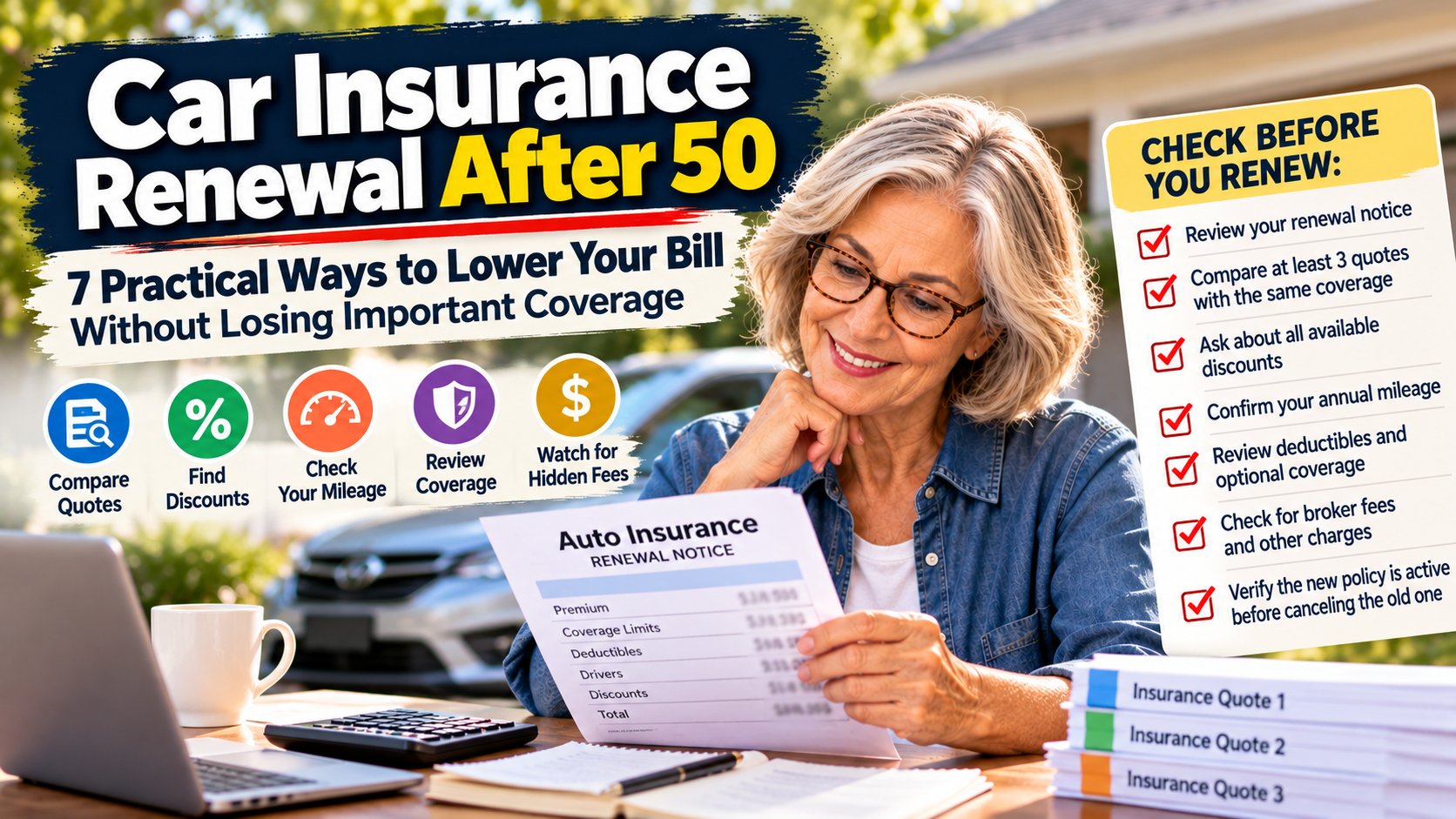
Your car insurance renewal premium went up? Learn how to compare quotes, find overlooked discounts, avoid hidden fees, and protect yourself from costly coverage mistakes.
Information reviewed: October 9, 2026
Your car insurance renewal notice arrives, and the price is higher than you expected. Should you stay with your insurer, shop around, or raise your deductible?
A cheaper insurance policy is not necessarily a better deal. Reducing important coverage just to lower your bill could leave you responsible for substantial costs after an accident.
This guide helps you review your policy, compare offers fairly, and verify whether a change would actually save money. It includes practical scripts, situations, a worksheet, and California-specific information.
Start Here: Your 15-Minute Car Insurance Check
Find your renewal notice, current policy Declarations Page (Dec Page), and most recent insurance bill. Write down:
| What to find | Why it matters |
|---|---|
| Current and renewal premium | Shows whether the price changed |
| Liability coverage limits | Shows protection for covered injuries and property damage you cause |
| Collision deductible | Your share of a covered collision claim subject to the deductible |
| Comprehensive deductible | Your share of a covered non-collision claim subject to the deductible |
| Estimated annual mileage | May affect your rate |
Also check drivers, vehicles, address, and optional coverages. Ask your insurer for the Dec Page if needed. First understand what you have; do not rush to change it.
1. Ask Why Your Renewal Premium Changed
Premiums can change because of insurer rate adjustments, repair costs, claims experience, policy details, or other factors permitted by state rules. Ask: “Can you explain what changed between my current policy and my renewal offer?”
- Was there an insurer-wide rate adjustment?
- Did a driving-history or claims factor change?
- Were any drivers, vehicles, or mileage details updated?
- Did coverage, deductibles, or discounts change?
One question many drivers forget
“Did any discount on my previous policy disappear at renewal?” If so, ask why and whether you can qualify again. Request corrections for inaccurate information rather than assuming an error.
If you recently retired
Your insurer may still have your former commute on record. Compare your listed annual mileage with actual and expected driving. Ask whether an accurate update changes your premium; a reduction is not guaranteed. Always report your real driving circumstances.
2. Compare Three Quotes With the Same Coverage
Ask at least three insurers for written quotes using the same drivers, vehicles, liability limits, uninsured/underinsured motorist coverage where applicable, collision and comprehensive coverage, deductibles, optional benefits, and policy term.
Do not compare a six-month premium directly with a 12-month premium. Ask about fees and temporary or conditional discounts.
Example: The cheapest quote may not be comparable
| Item | Current | Quote A | Quote B |
|---|---|---|---|
| Annual premium | $2,400 | $2,040 | $1,920 |
| Liability limits | Same | Same | Same |
| Collision deductible | $500 | $500 | $1,000 |
| Comprehensive deductible | $500 | $500 | $500 |
| Premium difference | — | $360 lower | $480 lower |
Fictional figures for illustration only—not real quotes or typical savings. Quote B has a $500 higher collision deductible, so it is not an identical-coverage comparison. Compare your current coverage unchanged first; evaluate any reductions separately.
California drivers can use the California Department of Insurance premium comparison resource to identify companies. Sample premiums are not personalized binding quotes. See also insurer quote contacts.
3. Check Discounts You May Be Missing
Ask your insurer to review eligibility for good-driver, multi-car, multi-policy, approved driver-education, vehicle safety, anti-theft, payment-method, and other available discounts. Discounts vary, may apply only to parts of the premium, and may not combine.
California: Mature driver education for ages 55 and older
Eligible California drivers 55 or older who complete a DMV-approved mature driver improvement course may qualify for a premium reduction. The initial course is eight hours; the refresher is four hours; completion certificates are valid for three years, subject to applicable requirements.
- Choose a provider from the DMV-approved provider list.
- Ask your insurer to confirm eligibility.
- Get the estimated discount in dollars before paying for a course.
- Compare the savings with course costs and ask how to submit the certificate.
Hypothetical example: a $30 course with a confirmed $15 annual reduction for three years would produce $45 in nominal premium reductions, or $15 after the course cost, assuming continuing eligibility and unchanged terms. This is not a guaranteed result.
California: Good Driver rating
California’s Good Driver rules provide a qualifying-driver rate at least 20% lower than the rate for an otherwise comparable nonqualifying driver at the same insurer. This is not necessarily an additional 20% discount on your current bill; it may already be included. Ask: “Am I rated as a California Good Driver, and is that reflected in my premium?”
4. Confirm Your Annual Mileage
If you retired, changed jobs, reduced commuting, or began driving another vehicle more often, your insurer’s mileage estimate may be outdated. Compare dated odometer readings or service records and estimate future mileage accurately.
Ask: “What annual mileage is listed on my policy, and how can I update it accurately?” Check each insured vehicle separately. Never understate mileage to obtain a lower rate.
5. Review Deductibles and Optional Coverage Carefully
Ask for written premiums at your current deductible and a higher one. For example, increasing a collision deductible from $500 to $1,000 might reduce the annual premium by $80. That is an extra $500 you could owe on a covered collision claim subject to the deductible; more than six claim-free years of $80 savings would be needed to exceed $500, assuming unchanged premiums. This does not predict accidents.
Older vehicles
Compare vehicle value, the separate premiums for collision and comprehensive, deductibles, ability to replace the car, theft and weather risks, and any lender or lease requirements. Vehicle age alone is not a reason to cancel coverage.
Overlapping roadside benefits
Compare towing, roadside, rental, and assistance benefits against automobile clubs, manufacturer plans, or other services. Similar names may hide different exclusions and limits.
6. Watch for Hidden Fees and Check the Insurer
Ask for the total cost for the same policy term, including broker fees, installment charges, other fees, possible cancellation charges, and any optional products or conditional discounts.
California broker fees
Broker fees can be separate from insurance premiums, may be negotiable, and may be nonrefundable. Review the disclosure and refund terms before agreeing. See the California broker fee disclosure rules.
Verify licensing and complaint history
Check the California insurer and agent/broker information and consumer complaint study. Complaint statistics inform your assessment but do not guarantee future claim service. In other states, consult your state insurance department.
Protect your personal information
Some comparison websites are marketing lead generators. Determine who receives your details and review the privacy notice. Do not provide passwords, authentication codes, or unrelated financial account information for a quote.
What if the online quote changes?
Ask: “Why is the final premium different from the original quote? Please show what information, coverage, discount, or fee changed.” Request a new written offer and compare the final price. Never cancel existing insurance based on a preliminary quote.
7. Switch Insurers Safely and Verify Your Savings
Before canceling your old policy, confirm that the replacement policy is issued and active at the required date and time. Check insured drivers and vehicles, limits, deductibles, lender requirements, payment schedule, fees, and the old policy’s cancellation/refund terms.
Request written confirmation of both the new coverage and old cancellation when appropriate. A quote request alone does not create coverage.
Calculate actual savings
Old policy cost − new policy cost − additional switching costs = estimated savings, assuming equivalent coverage and the same period.
| Illustrative item | Amount |
|---|---|
| Old annual premium | $2,400 |
| New annual premium | $2,040 |
| Additional switching costs | $40 |
| Estimated first-year difference | $320 |
Fictional example, assuming equivalent coverage and comparable terms. If switching midterm, account for dates, refunds, payments, and cancellation adjustments. Confirm the issued policy and actual bills before recording verified savings.
What If an Insurer Will Not Cover You?
Ask whether the company can explain its decision and whether the information it used is accurate. Keep a record of the insurer, date, and response. Contact other licensed insurers or agents and your state insurance department for assistance. Some states have assigned-risk or other availability programs with specific eligibility rules. Do not drive uninsured while searching for a replacement.
California Drivers: Two Important Rules and Programs
Standard minimum liability limits
Since January 1, 2025, California’s standard minimum automobile liability limits have been $30,000 per person / $60,000 per accident for bodily injury or death / $15,000 for property damage. Minimum limits may be insufficient for serious losses.
California Low Cost Automobile Insurance Program
Eligible lower-income drivers may qualify for California’s special low-cost liability program, subject to licensing, income, vehicle-value, and driving-history requirements. Its basic limits are $10,000 per person / $20,000 per accident bodily injury or death / $3,000 property damage, below the standard limits. The reduced protection can expose you to significant personal costs. It is not a nationwide program or an automatic senior discount. Review eligibility and terms at California Low Cost Auto Insurance.
Your Car Insurance Renewal Comparison Worksheet
| Compare | Current | Quote A | Quote B |
|---|---|---|---|
| Policy term | _____ | _____ | _____ |
| Premium for that term | $_____ | $_____ | $_____ |
| Liability limits | _____ | _____ | _____ |
| Uninsured/underinsured coverage | _____ | _____ | _____ |
| Collision deductible | $_____ | $_____ | $_____ |
| Comprehensive deductible | $_____ | $_____ | $_____ |
| Optional coverage | _____ | _____ | _____ |
| Annual mileage | _____ | _____ | _____ |
| Confirmed discounts | _____ | _____ | _____ |
| Additional fees | $_____ | $_____ | $_____ |
| Total comparable cost | $_____ | $_____ | $_____ |
| Company/agent verified | _____ | _____ | _____ |
| Final written quote received | _____ | _____ | _____ |
Mark different coverage limits or deductibles as not directly comparable. Do not assume a future renewal premium is guaranteed. Keep your worksheet private; omit full license and payment-card numbers.
A Phone Script You Can Use Today
“Hello, my car insurance is coming up for renewal, and I’d like to review my premium. Could you explain why my renewal price changed? Please confirm my annual mileage, current discounts, coverage limits, and deductibles. Could you check whether I’m eligible for any additional discounts? I’d also like a written quote with my current coverage unchanged, including any fees. Thank you.”
You do not need to agree to a change during the call. Request written details for comparison.
Your Seven-Point Renewal Checklist
- ☐ Review the renewal notice and Declarations Page.
- ☐ Ask why the premium changed.
- ☐ Confirm mileage and discounts.
- ☐ Compare three written quotes with equivalent coverage.
- ☐ Check deductibles, optional coverage, and fees.
- ☐ Verify the insurer or agent and activate replacement coverage before canceling the old policy.
- ☐ Review final charges before recording actual savings.
Frequently Asked Questions
Does turning 50 automatically lower car insurance?
No. Some programs are available to eligible mature drivers, but age 50 alone does not guarantee a discount.
Should I switch insurers every year?
Not necessarily. Compare the total cost, coverage, insurer, and terms before deciding.
Can I lower my premium without switching?
Possibly, through accurate policy information, eligible discounts, or carefully considered coverage changes.
Should I raise my deductible?
Only if the premium reduction makes sense and you can afford the higher deductible after a claim.
Is legal minimum liability coverage enough?
Not necessarily. You could owe amounts exceeding policy limits.
What if my insurer will not correct inaccurate information?
Request its review or appeal process. If unresolved, contact your state insurance department.
The Bottom Line
Do not accept a higher renewal price without asking questions. Check your policy, mileage, discounts, fees, and comparable quotes. Confirm new coverage before canceling old coverage, and verify what you actually paid.
The goal is not simply the lowest bill. It is a reasonable price for protection that meets your needs.
Official Resources
- National Association of Insurance Commissioners — Auto Insurance
- California Department of Insurance — Automobile Insurance Guide
- California — Compare Insurance Premiums
- California — Auto Insurance Quote Contacts
- California DMV — Approved Mature Driver Improvement Providers
- California — Broker Fee Disclosure
- California — Company and Agent Information
- California — Consumer Complaint Study
- California Low Cost Auto Insurance
This article provides general educational information, not individualized insurance, financial, or legal advice. Insurance rules, eligibility, premiums, discounts, and fees vary by state, insurer, and individual circumstances. Confirm current terms with your insurer and state insurance department before making important coverage decisions.