
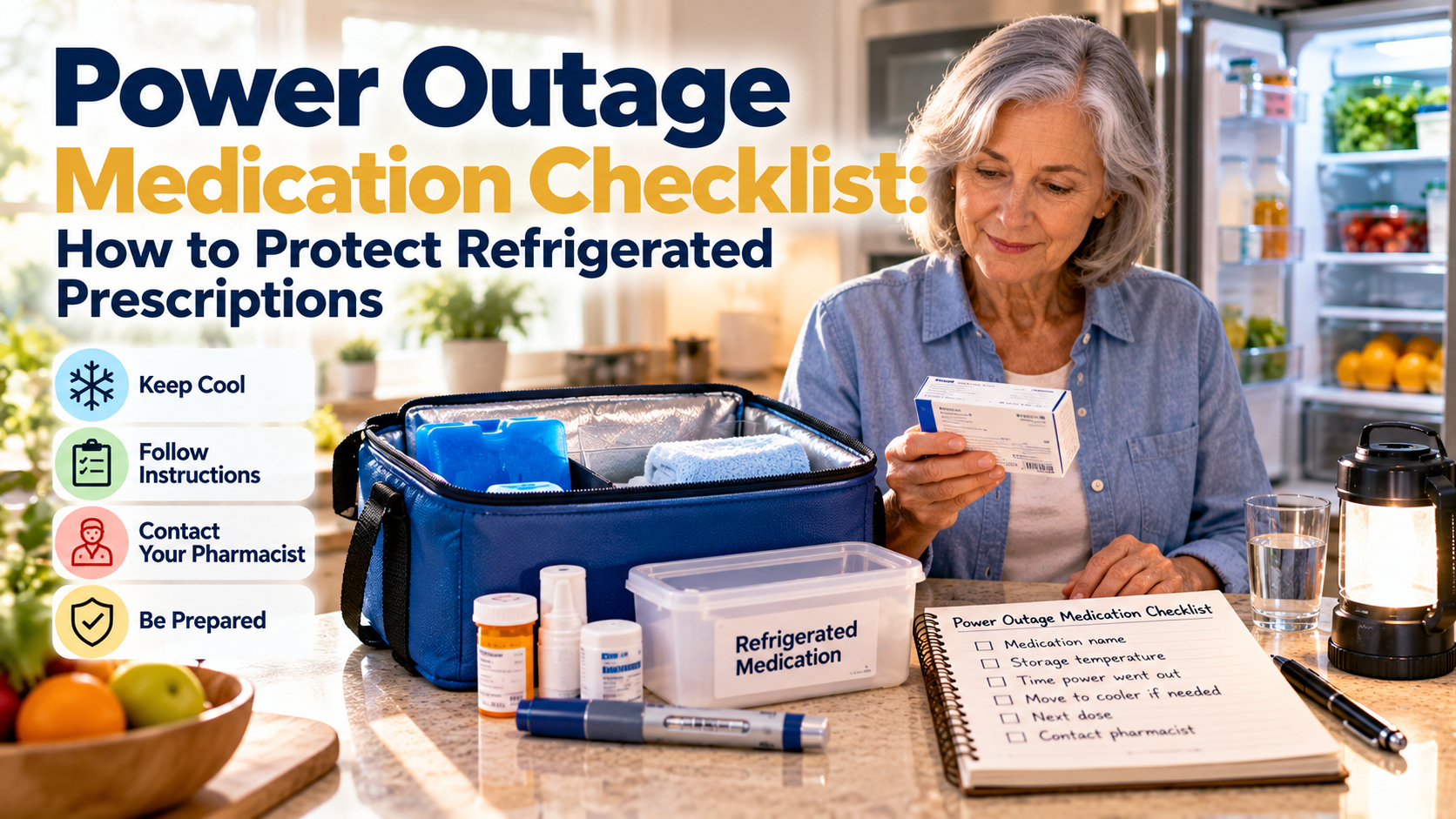
What to do when the refrigerator stops working, how to protect temperature-sensitive medicine, and when to ask a pharmacist for help.
Information reviewed: October 12, 2026
Imagine waking up after a storm to find the clocks blinking and the refrigerator silent. The power went out sometime overnight, and you have no idea how long your medication has been sitting inside without refrigeration.
The groceries can wait a moment. But what about the prescription injection on the middle shelf?
Should you keep the refrigerator closed? Move the medicine into a cooler? Is it still safe to use when your next dose is due?
Here’s the important part: There isn’t one simple rule that works for every refrigerated medicine.
The answer depends on the exact product, whether it has been opened, how warm or cold it became, and how long it was exposed to those conditions.
You don’t need to make that decision alone. You do need a practical plan and a few pieces of information your pharmacist can use.
Quick Answer: What Should You Do First?
If the power is out and you have refrigerated medication:
- Write down when the outage started.
- Keep the refrigerator door closed as much as possible.
- Find the medicine’s exact storage instructions, including any differences between opened and unopened packages.
- Check when your next dose is due.
- Contact your pharmacist or healthcare professional if the medicine may have become too warm, may have frozen, or is needed before you can get a replacement.
Do not automatically throw away an essential medicine. Do not assume it remains usable just because it looks normal.
If a life-sustaining medicine is affected and replacement is not immediately available, seek urgent professional guidance. The FDA recognizes limited emergency exceptions for certain essential medicines, including insulin.
1. Identify Which Medicines Need Refrigeration
Start by checking the original packaging or official prescribing information.
Products that may require refrigeration include certain insulin products, injectable biologic medicines, liquid antibiotics, eye drops, and other prescription products.
But these categories do not all follow the same rules.
Even two medicines used for the same condition may have different storage requirements. Instructions may also differ depending on whether a container has been opened.
For each refrigerated prescription, record:
- Exact medicine and manufacturer
- Strength and formulation
- Opened or unopened status
- Labeled storage temperature
- Allowed time outside refrigeration, if specified
- Expiration date and any shorter in-use deadline
- Pharmacy or manufacturer contact information
Do not apply one medication’s storage instructions to another medication.
2. Protect the Medicine While the Power Is Out
Keep the refrigerator closed whenever possible.
Avoid repeatedly opening the door to check the medicine. If you have a refrigerator thermometer that records temperatures, use its readings to help document what happened.
If the outage is expected to continue, you may need an alternative cooling arrangement.
The FDA recommends planning ahead with a cooler and ice or frozen gel packs when appropriate, while following the medication’s labeled storage instructions.
However, a cooler is not automatically a safe refrigerator substitute.
Three precautions matter:
Avoid freezing. Do not put temperature-sensitive medication directly against ice or frozen packs unless the product instructions specifically permit that arrangement.
Avoid heat and sunlight. Do not leave medicine in a hot vehicle, near a window, or outdoors in direct sunlight.
Monitor temperature when possible. A thermometer can provide useful information, but it does not replace product-specific storage guidance.
If you are unsure whether a cooler can maintain the required range, ask your pharmacist how to prepare a suitable backup system for your medication.
3. What If Your Medicine Gets Too Warm?
The next step depends on what happened.
| Situation | Safest next action |
|---|---|
| Power has just gone out | Record the time, keep the refrigerator closed, and review storage instructions. |
| Medicine was above its recommended temperature | Contact a pharmacist or manufacturer with the product name, temperature information, and estimated exposure time. |
| Temperature is unknown | Explain what is known and unknown. Do not invent a temperature estimate. |
| Medicine may have frozen | Seek product-specific guidance. Do not assume thawing makes it usable again. |
| Your next essential dose is due soon | Contact your pharmacist or healthcare team promptly about treatment and replacement options. |
| Electricity has returned | Record the outage duration and confirm whether the medicine can still be used. |
Do not confuse food safety with medicine safety
An unopened refrigerator is often discussed in terms of a four-hour food-safety guideline.
That is not a universal medication stability limit.
A prescription may have different requirements based on its formulation, manufacturer, and labeling.
The correct decision is based on the particular medicine—not simply the number of hours the electricity was off.
4. Special Considerations for Insulin
Insulin deserves particular attention because interruption of treatment can be dangerous.
The FDA explains that many insulin products have emergency storage allowances, but the applicable limits depend on the product and its instructions.
The CDC advises keeping insulin as cool as possible without freezing it, and protecting it from direct heat and sunlight.
If insulin has been exposed to excessive heat during an emergency, a person may sometimes need to continue using an available supply until a properly stored replacement can be obtained.
This is not a guarantee that heat-exposed insulin remains fully effective.
Follow the guidance for your specific insulin. Contact your diabetes care team promptly, monitor blood glucose as directed, and seek urgent medical attention for concerning symptoms or readings.
Never switch insulin products or change doses on your own simply because the power is out.
For product-specific emergency guidance, see the FDA’s official Information Regarding Insulin Storage and Switching Between Products in an Emergency.
5. Use This Power Outage Medication Record
A written record helps your pharmacist understand what happened.
Copy this table onto paper and keep it with your emergency supplies.
| Question | Your information |
|---|---|
| Medicine name and strength | __________________ |
| Manufacturer | __________________ |
| Opened or unopened | __________________ |
| Required storage range | __________________ |
| Date and time power failed | __________________ |
| Date and time power returned | __________________ |
| Highest or lowest known temperature | __________________ |
| Was the medicine moved to a cooler? | __________________ |
| Could it have frozen? | __________________ |
| Next scheduled dose | __________________ |
| Pharmacist or manufacturer contacted | __________________ |
| Advice received | __________________ |
| Replacement arranged | __________________ |
If you do not know the temperature, write “Unknown.” An accurate record of uncertainty is better than a guess.
Keep the completed record private because it contains health information.
6. Seven Questions to Ask Your Pharmacist
When you call, have the medicine’s packaging nearby.
Ask:
- What is the correct storage range for this exact product?
- Are the instructions different after the package has been opened?
- How long can this product be outside its recommended range?
- What if I do not know the highest temperature it reached?
- What if the medicine accidentally froze?
- Should I continue using this supply, obtain a replacement, or speak with my prescriber?
- What can I do if my next dose is due before the pharmacy reopens?
The pharmacist may need to consult the manufacturer.
If you cannot reach your regular pharmacy, seek another licensed pharmacy or an appropriate healthcare service rather than relying on guesses from social media.
7. What to Do When the Power Returns
Restored electricity does not automatically mean the medicine is still suitable for use.
Before returning to your normal routine:
- Write down when power returned.
- Record available temperature readings.
- Check whether the medicine was exposed to freezing, unusual heat, water, or damaged packaging.
- Ask a pharmacist whether the affected supply remains usable.
- Obtain replacements when recommended.
- Update your emergency plan based on what happened.
A medicine can lose potency without a visible change in appearance.
If a product must be discarded, ask your pharmacist about appropriate disposal rather than putting it back into normal use.
8. Prepare Before the Next Power Outage
You can reduce uncertainty with a simple plan made before an emergency.
Your 10-Minute Medication Readiness Checklist
- List all prescriptions and medical products that require refrigeration.
- Save the official storage instructions for each product.
- Record the phone number of your pharmacy.
- Ask how to handle an overnight or multi-day power outage.
- Identify a suitable backup cooling arrangement.
- Consider a refrigerator thermometer with temperature-history capability.
- Keep a current medication list and copies of prescriptions in your emergency supplies.
- Ask about emergency refill rules and replacement options.
- Make a plan for essential doses if your pharmacy is closed.
- Tell a trusted family member or caregiver where the plan is kept.
If you rely on an electrically powered medical device, make a separate backup-power plan with your healthcare team. A medicine cooler does not solve the power needs of medical equipment.
9. Example: A Power Outage Overnight
Imagine that your father uses a refrigerated prescription injection.
The electricity goes out at 10 p.m. He keeps the refrigerator closed and writes down the time.
At 7 a.m., the power is still out. His next dose is scheduled for the following day.
Rather than guessing whether the medicine is still usable, you help him find the product name, storage instructions, and any available temperature information.
You call his pharmacist and explain what happened.
The pharmacist checks the exact product’s storage guidance and helps determine whether the medicine can be used, requires replacement, or needs additional evaluation.
The key is not guessing how long medicine can survive without electricity. It is knowing what information to collect and whom to contact.
10. The One Thing to Do Today
Choose the refrigerated prescription in your household that would be hardest to replace during an emergency.
Find its official storage instructions.
Then ask your pharmacist:
“If we lose power overnight, what should we do with this exact medicine?”
Write down the answer and keep it with your emergency supplies.
A short conversation today may prevent confusion during the next outage.
Official Sources and Further Reading
- FDA — Safe Drug Use After a Natural Disaster
- FDA — Information Regarding Insulin Storage and Switching Between Products in an Emergency
- CDC — Managing Insulin in an Emergency
- FDA — Natural Disaster Preparedness and Response
Medical Disclaimer
This article provides general educational information and does not replace individualized medical advice, diagnosis, or treatment. Medication storage requirements vary by product and circumstances. Consult your pharmacist or healthcare professional before deciding whether temperature-exposed medicine can be used, replaced, or discarded. If you believe you are experiencing a medical emergency, call 911 or seek emergency medical care immediately.
Wise Years Living — Practical information for safer, more confident everyday living.