
Information reviewed: October 14, 2026
A credit freeze is a free way to make it harder for someone to open new credit accounts in your name without your permission.
You do not have to be a victim of identity theft to use one. And you do not need to pay for credit monitoring or a credit-lock subscription.
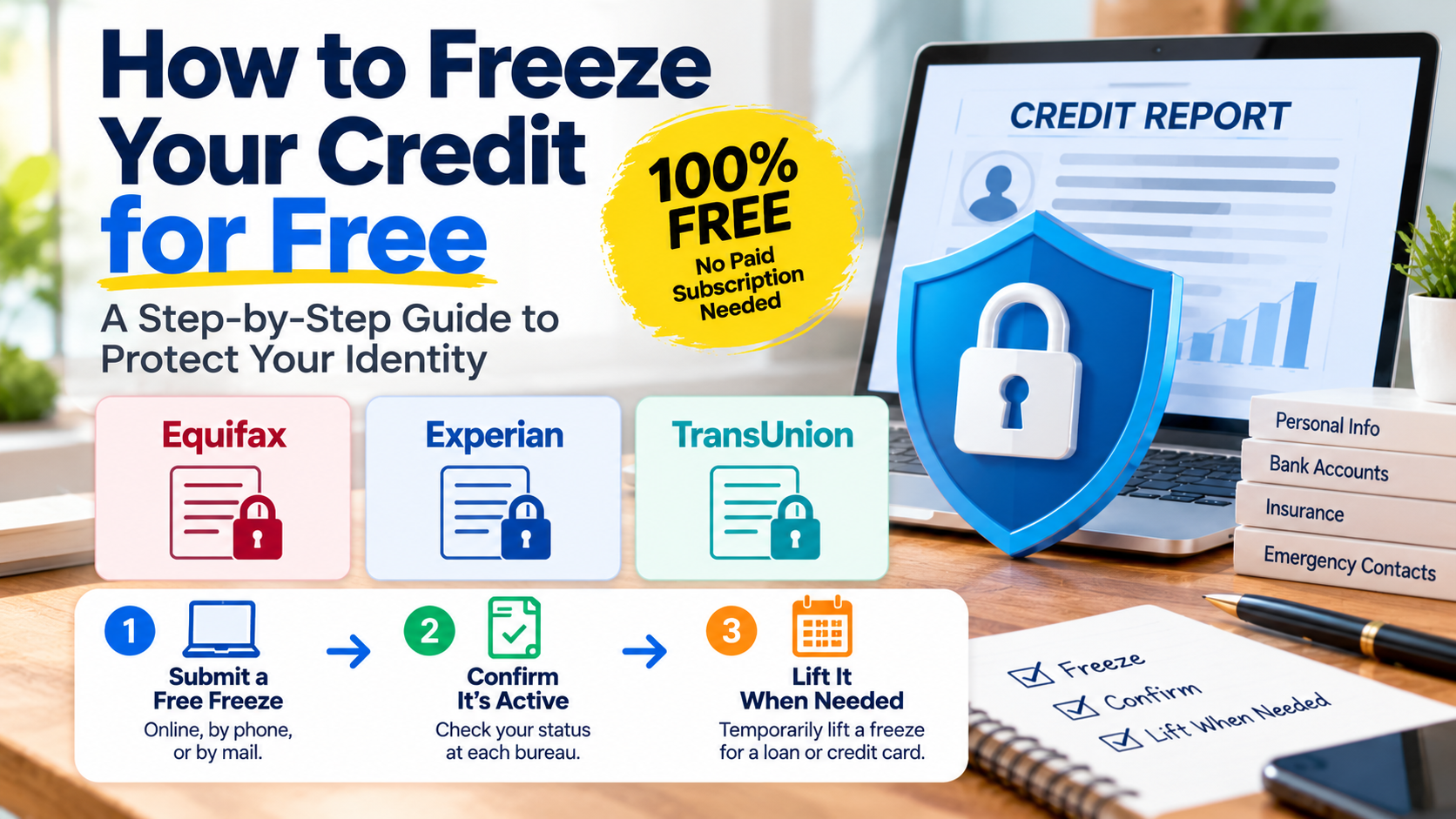
The most important thing to know: You must freeze your credit separately at Equifax, Experian, and TransUnion.
This guide shows you where to start, how to confirm your freezes, what to do if something goes wrong, and how to temporarily lift a freeze when you need new credit.
Start Here: Which Situation Applies to You?
You have never frozen your credit: Follow Steps 1 through 3 to place and confirm freezes with all three credit bureaus.
You froze your credit years ago: Check your status at each bureau. You do not need to submit a new request if your freeze is already active.
You are applying for a car loan, mortgage, or credit card: Read Step 4 to learn how to temporarily lift the appropriate freeze.
You suspect someone has stolen your identity: Contact any affected financial institution promptly and follow the recovery guidance near the end of this article.
You are helping a family member: Read the section on authorized assistance before accessing another person’s information.
Step 1: Prepare Safely
Use a trusted device and open each credit bureau’s official website yourself.
You may need your legal name, date of birth, Social Security number, current and previous addresses, and other information to verify your identity.
Only provide sensitive information through an official website, verified telephone service, or the bureau’s published mail procedure.
Avoid unexpected emails, text messages, advertisements, or callers that direct you to a paid service.
A security freeze is free under federal law.
Step 2: Freeze Your Credit at All Three Bureaus
Equifax
Official website: https://www.equifax.com/personal/credit-report-services/credit-freeze/
- Open the official Equifax credit-freeze page.
- Sign in to or create a myEquifax account.
- Find the security-freeze management option.
- Request a security freeze and complete identity verification.
- Check your freeze status and save the confirmation securely.
Need assistance? Call Equifax at 888-298-0045 or follow its official instructions for requesting a freeze by mail.
Do not confuse a free security freeze with an optional credit-lock or monitoring product.
Experian
Official website: https://www.experian.com/help/credit-freeze/
- Open Experian’s official credit-freeze page.
- Sign in or follow the instructions to access its free freeze-management service.
- Select the security-freeze option.
- Complete the identity-verification process.
- Check whether your freeze is active.
Need assistance? Call Experian at 888-397-3742 or use its official mail instructions.
You do not need to purchase Experian CreditLock to place a free security freeze.
TransUnion
Official website: https://www.transunion.com/credit-freeze
- Open the official TransUnion credit-freeze page.
- Sign in to or create a free TransUnion Service Center account.
- Find the option to add a credit freeze.
- Complete any required identity verification.
- Check your freeze status and save the confirmation securely.
Telephone options:
- Automated freeze management: 888-909-8872
- Consumer Relations assistance: 800-916-8800
For telephone and mail instructions, visit:
https://www.transunion.com/credit-freeze/mail-or-phone
Remember: Website buttons and account screens can change. Follow the bureau’s current official instructions rather than an outdated screenshot.
Step 3: Confirm All Three Freezes Are Active
Submitting a request is not necessarily the same as completing a freeze.
Return to each bureau’s official freeze-management service or contact its support channel to confirm your status
Your Credit Freeze Completion Tracker
Use this simple tracker to confirm that your credit is frozen at all three credit bureaus. Check each box only after the bureau confirms that your freeze is active.
- ☐ Equifax — Freeze confirmed active
Date confirmed: __________ - ☐ Experian — Freeze confirmed active
Date confirmed: __________ - ☐ TransUnion — Freeze confirmed active
Date confirmed: __________
Before you finish:
- ☐ Save your confirmation notices in a secure location.
- ☐ Make sure you know how to access or recover each bureau account.
- ☐ Confirm all three freezes are active before marking this task complete.
Privacy reminder: Never write your Social Security number, passwords, or account recovery codes on this checklist.
Need to apply for credit later? Ask your lender which credit bureau it will use, then arrange a temporary lift with that bureau. Check that your freeze is active again afterward.
How Long Does a Credit Freeze Take?
Federal law establishes these processing deadlines:
| Request method | Placing a freeze | Lifting or removing a freeze |
|---|---|---|
| Online or telephone | Within 1 business day | Within 1 hour |
| Within 3 business days after receipt | Within 3 business days after receipt |
These are legal processing deadlines, not guarantees that every request will take effect immediately.
If a request remains pending, check again after the applicable processing period. Contact the bureau if the status is unclear.
Do not mark a freeze complete until you have verified it.
Source: Consumer Financial Protection Bureau (CFPB) — Credit Freeze Rules and Processing Times
Step 4: Temporarily Lift a Freeze When You Need Credit
A credit freeze does not mean you can never apply for another credit card, car loan, or mortgage.
You can temporarily lift a freeze when a lender needs access to your credit report.
Example: Applying for a Car Loan
Suppose you plan to apply for an auto loan next Tuesday.
- Ask the lender which credit bureau or bureaus it expects to check.
- Ask when it plans to access your credit report.
- Sign in to the appropriate bureau’s official freeze-management service.
- Request a temporary lift for the necessary period.
- Confirm the lift has taken effect before the lender checks your report.
- Afterward, confirm that your freeze is active again.
If the lender cannot identify which bureau it will use, you may need to arrange temporary lifts with more than one bureau.
A temporary lift is generally preferable to permanently removing your freeze when you only need access for a short period.
Important: Allow enough processing time. An online or telephone lift must be processed within one hour, but you should not assume it is instantaneous.
Step 5: What to Do When Something Goes Wrong
I Cannot Sign In
Try the bureau’s official account-recovery process.
Check whether you already have an account before registering again.
If account recovery fails, use the bureau’s verified telephone or mail option.
The Bureau Cannot Verify My Identity
A recent move, legal name change, or inconsistent personal records may require additional verification.
Follow the bureau’s instructions for submitting supporting documents.
Do not guess verification answers or send identification documents to an unverified email address.
I Am Being Asked to Pay
Check whether you selected a credit lock, monitoring membership, or another optional product.
Placing, temporarily lifting, and removing a security freeze are free.
You do not need a paid subscription to freeze your credit.
I Submitted a Request but Cannot Confirm the Freeze
Return to the bureau’s official freeze-management service and check your status.
If the status remains unclear after the applicable processing period, contact the bureau directly.
Keep a secure record of the request date and any confirmation you received.
A Lender Says It Cannot Access My Credit Report
Ask which bureau the lender tried to use and when it requested the report.
Check whether your temporary lift applies to the correct bureau and dates.
If the problem continues, contact that bureau through its official support channel.
The Bureau Has Not Resolved My Problem
Document the dates of your requests and your communications with the bureau.
You can learn about submitting a complaint to the Consumer Financial Protection Bureau at:
What a Credit Freeze Does Not Protect
A credit freeze is useful, but it does not prevent every type of identity theft or financial fraud.
It generally does not stop:
- Unauthorized transactions on an existing credit card.
- Someone attempting to access an existing bank account.
- Scams that persuade you to send money.
- Every type of identity theft.
- All legally permitted access to your credit report.
A freeze also does not prevent you from reviewing your own credit reports or using credit cards you already have.
Continue checking your bank and credit-card statements and report unfamiliar activity promptly.
You can obtain free credit reports through the federally authorized website:
Credit Freeze vs. Fraud Alert
A credit freeze and a fraud alert are both free, but they work differently.
| Credit freeze | Initial fraud alert | |
|---|---|---|
| Purpose | Restricts access for most new-credit checks | Requires additional identity verification |
| Cost | Free | Free |
| How to request | Contact all three bureaus | Contact one bureau; it must notify the others |
| Duration | Until lifted or removed | One year; renewable |
| Can you use both? | Yes | Yes |
An extended fraud alert may be available to qualifying identity-theft victims.
For more information about fraud alerts and credit freezes, visit the Federal Trade Commission’s official guidance.
Your Next Step: Protect Your Credit for Free
If you have not frozen your credit, start with one bureau today and complete the other two. A freeze at only one bureau does not cover all three.
Before you finish, confirm that each freeze is active and keep your account recovery information in a secure place.
If you believe someone has already stolen your identity, visit IdentityTheft.gov for a personalized recovery plan.
Remember: A credit freeze is free, and you can temporarily lift it when you need to apply for credit.