
Information reviewed: September 23, 2026
Key Takeaways
- The first day after an ER visit is a good time to organize your discharge instructions, medicines, follow-up plan, and warning signs.
- Follow the instructions given by your healthcare team. Different conditions require different recovery plans.
- If a medicine was started, stopped, changed, or given in the ER, make sure you know exactly what to take next and when.
- Know which symptoms mean you should call your healthcare provider, return to the ER, or call 911.
- Keep your discharge papers nearby and involve a family member or caregiver when helpful.
You are finally home from the emergency room.
You may be tired, hungry, sore, worried, or simply relieved to be home.
But the first hours at home can also be when new questions appear.
When should I take my next medicine?
Was I supposed to stop one of my regular medicines?
Can I drive tomorrow?
Who am I supposed to call for follow-up?
Which symptoms mean I should go back?
These questions are not unusual.
Research on older adults discharged from emergency departments has found that understanding of discharge instructions can vary, particularly when it comes to medications.
The goal of this guide is simple:
Help you organize the first day at home so that you can follow your discharge plan as safely and clearly as possible.
A Note About “The First 24 Hours”
There is no single medical rule that every person must follow during the first 24 hours after an ER visit.
Your instructions depend on why you went to the ER, what tests or treatments you received, your medicines, your health conditions, and what your healthcare team told you.
In this guide, “the first 24 hours” is a practical organization period—not a universal medical deadline.
Always follow your own discharge instructions first.
Watch: How to Prepare for a Safe Transition Home
This AHRQ Patient Safety video uses a hospital discharge example, but it shows practical ways patients and family caregivers can prepare for going home, understand care instructions, and take part in a safer discharge plan.
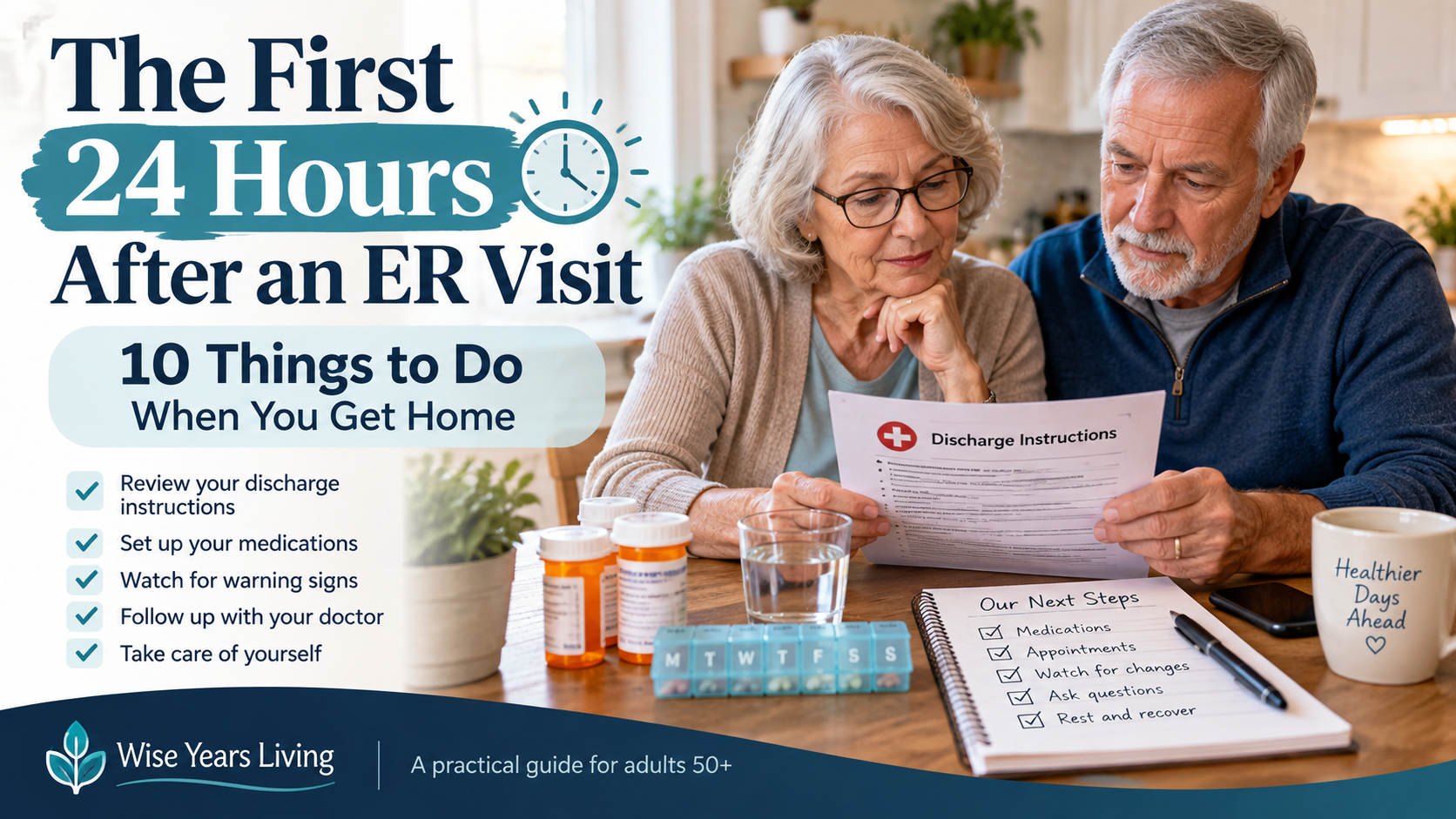
1. Put Your Discharge Papers in One Place
Before doing anything else, keep all of your ER paperwork together.
This may include:
- Your diagnosis or reason for the visit
- Test results
- Medicine instructions
- New prescriptions
- Follow-up instructions
- Activity restrictions
- Warning signs
- Phone numbers
- Information about pending test results
Do not put the papers somewhere you may forget about them.
Keep them in an easy-to-find place such as a kitchen table, desk, folder, or beside your medications.
If your healthcare system also provides instructions through an online patient portal, make sure you know how to access them.
For the questions that are useful before leaving the emergency room, see:
Before You Leave the ER After 50: 8 Questions to Ask
2. Check When Your Next Medicine Dose Is Due
This is one of the first things worth confirming when you get home.
You may have:
- Received medicine in the ER
- Been given a new prescription
- Had a regular medicine temporarily stopped
- Had a dose changed
- Been told to restart a medicine later
Look at your discharge instructions and make sure you understand:
Which medicine do I take next?
How much do I take?
What time do I take it?
Should I take it with food?
Did the ER already give me a dose today?
Do not guess if the timing is unclear.
If your written instructions do not answer the question, use the contact information provided by your healthcare team or pharmacist to ask for clarification.
3. Review Every Medicine That Changed
Do not look only at new prescriptions.
Compare your usual medication routine with the instructions you received from the ER.
Check whether anything was:
- Started
- Stopped
- Changed
- Temporarily held
- Restarted
This includes prescription medicines, over-the-counter medicines, and any other products your healthcare team specifically discussed.
Medication instructions deserve particular attention. A 2024 systematic review of older adults discharged from emergency departments found lower comprehension of medication instructions than of self-care and routine follow-up instructions.
If you take several medications, this may also be a good time to review:
Are Your Medicines Causing New Problems After 50? 7 Warning Signs to Review
Do not independently stop or change a prescription medicine unless a qualified healthcare professional has told you how to do so.
4. Check Whether Any Test Results Are Still Pending
Not every test result is necessarily finished before a person leaves the emergency department.
Look through your instructions for any mention of a pending:
- Laboratory test
- Culture
- Imaging interpretation
- Pathology result
- Other test or study
If something is pending, make sure you know:
Who will review the result?
How will I be notified?
When should I expect the result?
Who should I contact if I do not hear anything?
Do not assume that no phone call automatically means every pending result was normal.
Follow the plan provided by the ER or your healthcare team.
5. Read the Warning Signs Again
When you were discharged, you may have been given instructions about symptoms that should make you seek help.
Read those instructions again when you are home and less distracted.
Try to separate them into three groups:
Call your healthcare provider
Return to the emergency department
Call 911
The correct action depends on your condition and the instructions you received.
For potentially life-threatening symptoms, do not wait for a routine appointment.
For example, CDC advises calling 911 immediately for possible stroke symptoms such as sudden weakness or numbness, sudden confusion or trouble speaking, sudden vision problems, sudden severe headache, or sudden difficulty walking, balancing, or coordinating movement.
Your own discharge paperwork may list additional warning signs specific to your ER visit.
Keep that information somewhere easy to see.
6. Review What You Should—or Should Not—Do at Home
Do not assume that your normal routine should immediately continue.
Check whether your discharge instructions say anything about:
- Driving
- Using stairs
- Showering or bathing
- Exercise
- Lifting
- Returning to work
- Alcohol
- Food or fluids
- Using equipment such as a walker or cane
- Being alone
Restrictions vary greatly depending on the reason for the ER visit and the medicines or treatments you received.
For example, a person who received a sedating medicine may have very different instructions from someone treated for a minor wound.
Use your own discharge instructions rather than a general rule from the internet.
If weakness, dizziness, pain, or balance problems are making it harder to move around safely at home, you may also find this useful:
Home Fall-Safety Check for Adults Over 60: Fix These 7 Risks First
7. Decide Whether You Need Help at Home
Some people can return home and manage comfortably on their own.
Others may benefit from temporary help.
Ask yourself:
Can I safely get to the bathroom?
Can I prepare food and water?
Can I manage my medicines correctly?
Am I unusually dizzy, weak, sleepy, or unsteady?
Did my discharge instructions say that someone should stay with me?
If your healthcare team specifically told you to have someone with you, follow that instruction.
Even when it is not medically required, a trusted family member or caregiver can sometimes help organize paperwork, pick up prescriptions, listen for instructions, or help arrange follow-up care.
8. Put the Follow-Up Plan on Your Calendar
Do not let “follow up with your doctor” disappear into the paperwork.
Find the exact follow-up recommendation.
Look for:
- Who you should see
- How soon you should be seen
- Whether an appointment was already made
- A phone number
- A clinic or specialist name
- Any tests that should happen before the visit
Then put the deadline or appointment on your calendar.
AHRQ work focused specifically on older adults transitioning from the emergency department to home identifies follow-up as one of the key components of safer ED discharge.
If you cannot obtain the recommended appointment within the timeframe you were given, contact the office or healthcare professional listed in your discharge instructions and ask what you should do next.
9. Tell a Caregiver or Family Member the Important Parts
You do not need to tell everyone every medical detail.
But if someone is helping you, make sure that person knows the information they need.
That may include:
- What happened at the ER
- Which medicines changed
- When your next dose is due
- Which warning signs matter
- Whether any tests are pending
- Who needs to be contacted
- When follow-up is required
- Whether you need help with transportation or daily activities
If you live alone, consider keeping an important contact number somewhere easy to find.
If you are the caregiver, do not rely entirely on memory.
Use the written discharge plan.
10. Write Down Changes and Questions
You do not need to monitor every small sensation.
But if something meaningful changes, write it down.
For example:
- A new symptom
- A symptom that is getting worse
- Fever, if your instructions tell you to monitor it
- Dizziness or weakness
- Problems taking a new medicine
- Vomiting or difficulty eating or drinking
- A question about a test result
- A question about your follow-up plan
Record the time when useful.
This can make it easier to explain what has happened if you need to contact a healthcare professional.
But do not spend time taking notes during a possible emergency.
If you develop a symptom your discharge instructions identify as an emergency—or you believe you may be experiencing a medical emergency—seek emergency help immediately.
A Simple First-Night Check
Before you settle in for the night, see whether you can answer these questions:
- What was I told happened today?
- What medicine do I take next?
- What time is the next dose?
- Did any of my usual medicines change?
- Are any test results still pending?
- What warning signs should I watch for?
- Who do I call if I have a question?
- When is my follow-up?
- Are there activities I should avoid?
- Do I need someone to help me tonight?
If you cannot answer something important, look at your discharge instructions and use the contact information you were given.
If You Are Helping a Parent, Spouse, or Other Adult
The first day home can also be confusing for caregivers.
Rather than trying to remember everything that happened in the ER, focus on the practical plan.
Know:
- The next medication time
- Major medicine changes
- Warning signs
- Pending results
- Follow-up deadlines
- Activity restrictions
- Who to call
Keep the discharge paperwork available.
When appropriate, encourage the person to do as much as they can independently while helping with the parts that are confusing or difficult.
Download: My First 24 Hours After an ER Visit Checklist
Wise Years Living has created a large-print checklist to help adults 50+ and family caregivers organize important information during the first day after an emergency room visit.
Use it to record:
- Your diagnosis or reason for the ER visit
- Your next medicine dose and time
- Medicines that were started, stopped, or changed
- Pending test results
- Warning signs to watch for
- When to call your healthcare provider, return to the ER, or call 911
- Follow-up appointments and deadlines
- Activity restrictions
- Caregiver or family contact information
- New symptoms or questions
My First 24 Hours After an ER Visit Checklist(PDF)
Keep the completed checklist with your discharge paperwork and bring it to follow-up appointments when useful.
This checklist is for organization and communication only. It does not replace your ER discharge instructions, medical advice, diagnosis, or treatment.
Frequently Asked Questions
Should everyone rest for 24 hours after an ER visit?
No single rule applies to every ER visit.
The right activity level depends on your diagnosis, treatment, medicines, symptoms, and discharge instructions.
Follow the instructions provided by your healthcare team.
Should someone stay with me the first night?
Not everyone needs another person to stay with them.
Some conditions, treatments, or medications may lead a healthcare professional to recommend supervision or help at home.
Follow your own discharge instructions. If you are uncertain about whether it is safe to be alone, ask the healthcare team responsible for your care.
What if I feel worse after I get home?
Follow the warning signs and return precautions in your discharge instructions.
If your symptoms are worsening, contact the appropriate healthcare professional or return for urgent evaluation as instructed.
For symptoms that may represent a medical emergency, call 911 or seek emergency medical care immediately.
What if I forgot what the ER doctor told me?
Start with your written discharge instructions and patient portal, if available.
If important information is still unclear, use the contact information provided with your discharge paperwork.
Do not guess about medication doses or emergency warning signs.
Do I need to keep my ER paperwork?
Keep it available at least through your follow-up period.
It may contain information about your diagnosis, medicines, test results, warning signs, and recommended follow-up care.
The Most Important Thing to Remember
Important
Coming home from the ER does not mean that your care plan is finished.
During the first day at home, make sure you know:
- What you were told happened
- What medicines to take
- When to take them
- What warning signs require help
- Whether any results are still pending
- Who you need to follow up with
- What activities or restrictions apply to you
You do not need to memorize everything.
You do need to know where your instructions are and what to do next.
Sources
Centers for Disease Control and Prevention (CDC) — Signs and Symptoms of Stroke
Medical Disclaimer
This article is for general educational purposes only and does not replace individualized medical advice, diagnosis, emergency evaluation, or treatment. Follow the discharge instructions provided by your healthcare team. If you believe you or someone else may be experiencing a medical emergency, call 911 or seek emergency medical care immediately.