
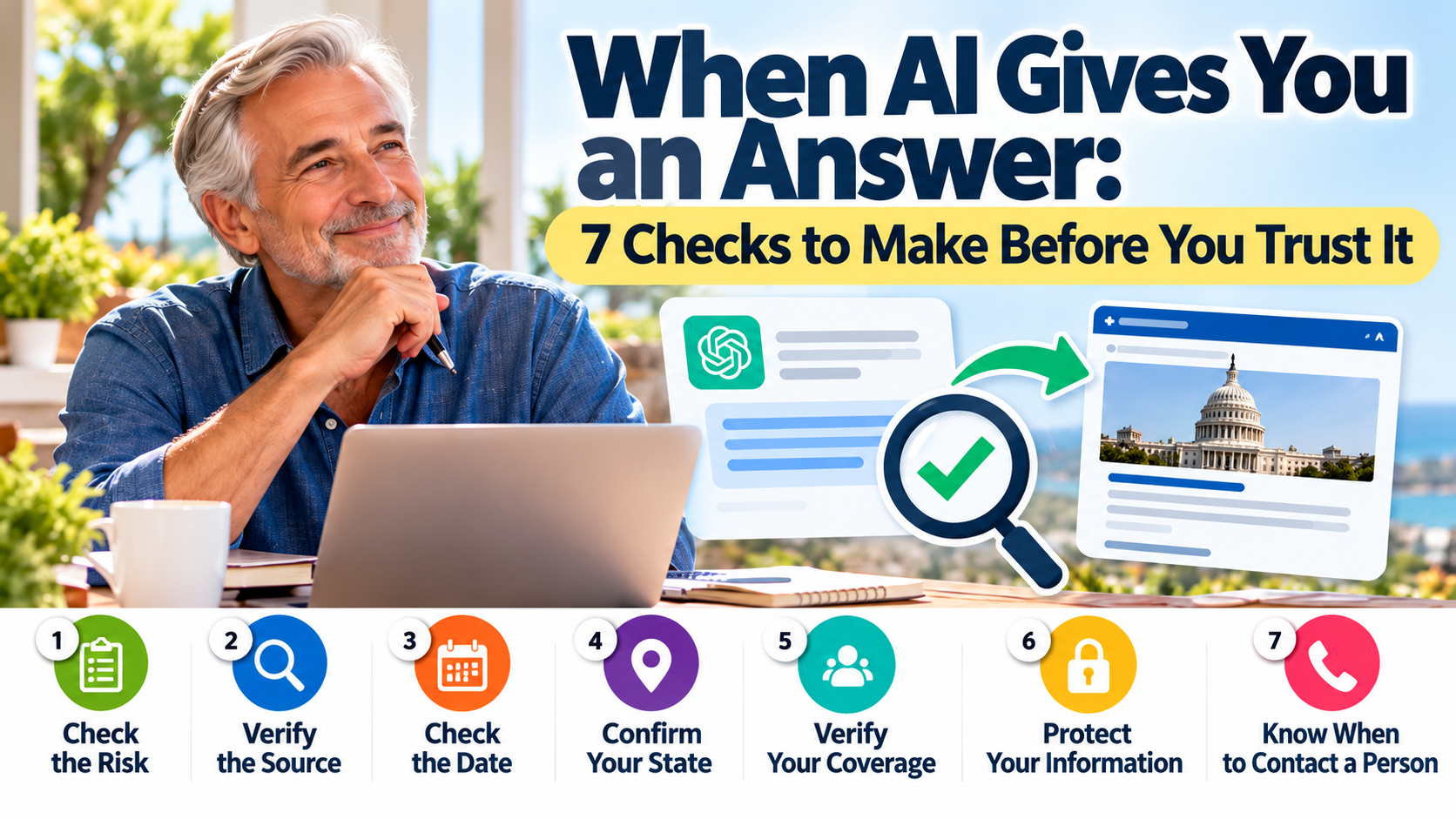
AI can save time, explain confusing information, and help you prepare better questions. But before you make a medical, financial, insurance, or legal decision, use these seven checks to make sure an answer is reliable.
Information reviewed: October 9, 2026
You ask an AI assistant a simple question:
“Can I change my Medicare plan?”
Or perhaps:
“Is this medical bill correct?”
Within seconds, you receive a detailed answer. It sounds clear, confident, and helpful.
But how do you know whether it is right?
Artificial intelligence can be an excellent starting point for learning. It can explain unfamiliar words, organize questions, and help you understand complicated instructions.
What it cannot guarantee is that every answer is accurate, current, or appropriate for your personal circumstances.
For adults and family caregivers, knowing when to double-check an AI answer can be just as important as knowing how to use AI.
Here is a practical system you can use before acting on important information.
First, Understand the Difference Between a Helpful Answer and a Verified Answer
An AI response may sound convincing even when a detail is incorrect.
It might misunderstand your question, leave out an exception, use outdated information, or describe a rule that does not apply to your state or situation.
A longer answer is not necessarily a more reliable answer.
Consider this example:
You ask whether a particular Medicare plan covers your doctor.
An AI assistant may explain how Medicare Advantage networks generally work. That explanation may be useful, but it does not establish whether your particular doctor participates in your specific plan.
The general explanation and the personal coverage decision are two different things.
That distinction is the foundation of safer AI use.
1. Decide How Much Harm a Wrong Answer Could Cause
Not every AI answer requires the same level of checking.
If you ask for a recipe idea or help writing a birthday message, a minor mistake may be easy to correct.
But other questions deserve much greater care.
| Your question involves | What to do before acting |
|---|---|
| Recipes, hobbies, or writing | Review the answer for usefulness |
| Phone or computer settings | Confirm the instructions match your device |
| Prices, discounts, or government benefits | Check the current official rules |
| Insurance, taxes, or retirement money | Verify details with the responsible institution or a qualified professional |
| Medications, symptoms, or treatment | Consult an appropriate healthcare professional |
| Legal rights or deadlines | Verify the applicable rules and seek qualified guidance when needed |
Simple rule: The more serious the possible consequences, the stronger the verification should be.
If the question involves urgent symptoms or immediate danger, do not delay emergency assistance while checking an AI response.
2. Ask Where the Information Came From
When an AI assistant gives you an important factual answer, ask:
“Please show me the original source for this information.”
Then look for a reliable source that actually supports the claim.
Useful starting points include:
- Medicare.gov for federal Medicare information.
- SSA.gov for Social Security information.
- IRS.gov for federal tax information.
- ConsumerFinance.gov for consumer financial information.
- Your state insurance department for state-specific insurance rules.
A source link is a starting point, not proof by itself.
Open it. Check that it leads to a real page, that the page addresses your question, and that the information supports what the AI said.
An AI assistant may cite a genuine website but misunderstand or overstate what the page says.
A Better Question to Ask AI
“Give me the official source, explain which part supports your answer, and identify anything you cannot verify.”
This encourages a more useful response, although it still does not replace checking the source yourself.
3. Check the Date — Especially for Benefits, Prices, and Rules
An answer that was accurate last year may be wrong today.
Government programs, insurance plans, prescription coverage, product prices, and online services can change.
For time-sensitive questions, check three dates:
- Publication date: When was the information first published?
- Effective date: When does the rule or benefit actually apply?
- Your decision date: Will the information still apply when you take action?
These dates are not always the same.
For example, an announcement about next year’s insurance coverage does not necessarily describe the benefits available today.
Try This AI Question
“What is the effective date of this rule? Please distinguish the announcement date from the date it takes effect.”
Then confirm the answer on the official website.
4. Make Sure the Answer Applies to Your State and Situation
AI sometimes provides a general U.S. answer when the correct answer depends on where you live.
That matters for subjects such as:
- Car insurance requirements
- Property taxes
- State assistance programs
- Consumer protection laws
- Estate planning
- Eligibility for certain benefits
Personal circumstances also matter.
Your age, employment status, current insurance, income, and enrollment history may affect the answer.
You do not need to share sensitive personal details with an AI assistant to get useful general guidance.
Instead, ask it to explain which factors could change the result.
Safer Prompt
“I live in California. Explain the general rules, identify any state-specific differences, and tell me what I should confirm with the official agency. Do not assume I qualify.”
You can then verify your individual situation directly with the appropriate organization.
5. Never Treat an AI Answer as Confirmation of Personal Coverage or Eligibility
This is one of the most important checks for anyone making a coverage or benefits decision.
Suppose an AI assistant tells you:
“You should qualify for this benefit.”
That statement is not the same as an eligibility determination by the agency responsible for the program.
Similarly, an AI explanation of insurance coverage does not guarantee that a claim will be paid.
Example: Medicare Plan Decisions
Medicare Advantage and Medicare Part D plans can have different provider networks, covered-drug lists, cost-sharing rules, and other coverage requirements.
If you need to know whether a particular doctor, prescription, or service is covered, verify the details using your plan’s current materials and the plan itself.
You can start at Medicare.gov or call 1-800-MEDICARE (1-800-633-4227) for general Medicare questions.
If you have a Medicare Advantage or Part D plan, contact your plan directly to confirm plan-specific coverage, costs, and provider or pharmacy information.
For free, personalized Medicare counseling, contact your local State Health Insurance Assistance Program (SHIP). SHIP counselors are not affiliated with insurance companies or health plans.
Learn more through Medicare’s official Get Help With Your Rights & Protections page.
The goal is not to stop using AI. It is to use AI to prepare better questions before making an important decision.
6. Protect Your Private Information While Asking Questions
An AI assistant does not need your full identity to explain most general topics.
Before pasting a letter, medical document, bank statement, or insurance notice into any AI tool, remove information that is unnecessary for the question.
Avoid sharing:
- Passwords or one-time verification codes
- Social Security numbers
- Medicare identification numbers
- Full bank or credit card numbers
- Account recovery information
- Unnecessary medical or family details
If you want help understanding a medical bill, for example, you can often ask about the meaning of a charge or billing term without providing your full name, account number, or address.
Also remember that a chatbot appearing on a website is not automatically trustworthy. Confirm that you are using the real organization’s website or app before entering personal information.
7. Know When to Stop Asking AI and Contact a Person
AI is particularly useful for explaining a problem and helping you prepare.
But sometimes you need an actual decision, investigation, or correction.
The Consumer Financial Protection Bureau has documented problems consumers can encounter with financial-service chatbots, including inaccurate information and difficulty reaching meaningful human assistance.
Read the CFPB’s report: Chatbots in Consumer Finance.
If an issue involves a disputed charge, an insurance denial, a medical concern, a legal deadline, or a government-benefit decision, the next step may need to be a real representative or qualified professional.
Use AI to Prepare for the Conversation
You might ask:
“Help me prepare five questions for my insurance company about this denied claim. Keep the questions clear and polite. Do not assume the denial was incorrect.”
Then contact the insurer through a verified channel.
When appropriate, ask for a written explanation, a reference number, or instructions for a formal appeal or complaint.
AI can help you organize the conversation. It cannot replace an institution’s official decision or required process.
A Practical 5-Minute AI Answer Check
Before acting on an important AI answer, use this checklist.
- Risk: Could a wrong answer cost me money, affect my health, or cause me to miss a deadline?
- Source: Did I find the original, trustworthy source?
- Date: Is the information current and effective now?
- Location: Does it apply to my state and circumstances?
- Personal decision: Am I confusing general guidance with an official eligibility or coverage decision?
- Privacy: Have I avoided sharing unnecessary sensitive information?
- Next step: Do I need confirmation from a real organization or qualified professional?
You do not need to memorize every detail. Save this checklist and return to it whenever an AI answer could affect an important decision.
REAL-LIFE EXAMPLE: HOW TO CHECK AN AI ANSWER
Suppose you ask AI, “Does Medicare cover my annual wellness visit?” AI answers, “Yes, Medicare covers it.”
Before scheduling, take three steps:
- Check the source: Visit Medicare.gov and search for “yearly wellness visits.”
- Check the details: Confirm the eligibility rules, the difference between a wellness visit and a routine physical exam, and whether additional services could result in charges.
- Confirm before acting: Ask your healthcare provider whether they accept Medicare assignment and whether the planned services may involve out-of-pocket costs.
The lesson: An AI answer may be generally correct but still leave out details that affect your bill. Verify those details before making a decision.
Three AI Prompts Worth Saving
These examples are designed to help you get more useful answers without relying on AI as the final authority.
Prompt 1: Check an Important Claim
“Explain this claim in plain English. Identify the official source, the effective date, any important exceptions, and what you cannot verify. Do not guess.”
Prompt 2: Prepare for a Phone Call
“I need to call an organization about this issue. Help me prepare five short questions, the documents I may need, and what I should ask them to confirm in writing. Do not request my personal account details.”
Prompt 3: Understand a Confusing Letter
“Explain the general meaning of this notice in simple language. Identify any stated deadlines, actions, or appeal instructions. Do not assume the notice is correct or that I qualify for a particular benefit. Tell me what I should verify with the sender.”
Before sharing a notice, remove unnecessary identifying information.
What If You Already Followed an Incorrect AI Answer?
You still have options.
First, stop any further action that depends on the questionable information, when it is safe to do so.
Next, identify exactly which statement may be wrong. Save the relevant dates, documents, and communications.
Contact the responsible organization through its official website or a verified phone number.
Explain what you did, ask what can be corrected, and request written instructions when possible.
If a deadline or potential loss is involved, act promptly. Do not assume that relying on AI automatically extends a deadline or creates an exception.
If you shared passwords or financial information with a suspicious service, use the appropriate account-security and fraud-reporting procedures rather than continuing the conversation with that service.
Frequently Asked Questions
Can I Trust ChatGPT, Gemini, Claude, or Copilot?
These tools can be helpful for learning, drafting, organizing, and explaining information. However, none should be treated as an infallible authority. Important facts and decisions still need independent verification.
Does an AI Answer Become Reliable If It Includes Links?
Not automatically. The link may be outdated, unrelated, or incorrectly interpreted. Open the original source and confirm that it supports the specific claim.
Should I Avoid AI for Medical or Financial Questions?
Not necessarily. AI can help explain terminology and prepare questions. But it should not replace individualized professional advice, official coverage decisions, or appropriate medical care.
What Is the Safest Way to Use AI for Important Decisions?
Use it as a helpful assistant, not as the final decision-maker. Ask clear questions, protect personal information, and verify high-impact answers with trustworthy original sources.
The Bottom Line
You do not need to become a technology expert to use AI wisely.
You only need a reliable habit:
Ask AI for help. Check important facts. Make decisions using verified information.
That approach allows you to benefit from new technology while protecting your health, money, privacy, and peace of mind.
Official Resources
- Consumer Financial Protection Bureau — Chatbots in Consumer Finance
- Medicare — Official Website
- Medicare — Get Help With Your Rights & Protections
- Social Security Administration
- Internal Revenue Service
- Consumer Financial Protection Bureau
Reader Notice: This article provides general educational information. It does not replace individualized medical, financial, insurance, tax, or legal advice. Program rules and personal circumstances vary. Confirm important decisions with the responsible organization or an appropriately qualified professional.